April 24, 2026

Lukasz Paciorkowski
Founder
Early Access is open. Here's what you get.
Early access to DesignFoundry is open today. Here's the honest version of what's inside, who it's for, and how the pricing works.
We've been heads-down building DesignFoundry. Today we're opening early access to architecture teams who want to try a different approach to enterprise modeling.
The door is open: if you're an architecture team that's been wondering whether there's a better way to do this work, you can come see for yourself.
Below is the honest version of what you get, who it's for, and how the pricing works.
What you get
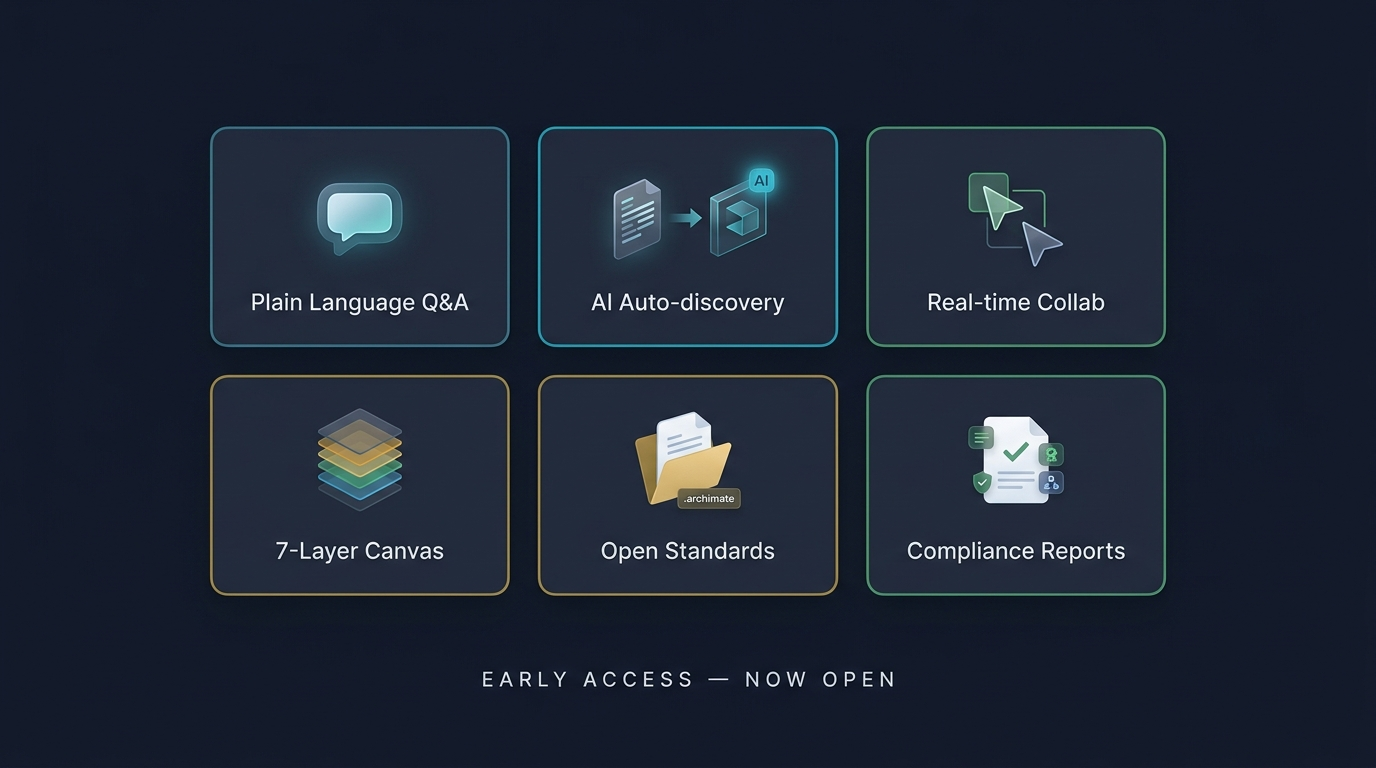
Six capabilities, available from day one of early access:
Plain language Q&A
Ask your architecture model questions in your own words and get accurate, structured answers with citations back to the model. "Which systems handle customer PII?" "What depends on this database?" "What's our exposure to vendor X?" These don't have to be tickets anymore.
AI auto-discovery
Upload your existing architecture documentation — PDFs, Word documents, Confluence exports, integration specs — and DesignFoundry extracts the entities, maps the relationships, and produces a complete ArchiMate 3.2 model. The architect's role becomes review and correction rather than building from scratch. Days, not months.
Real-time collaboration
Multiple architects can work on the same model at the same time, across all seven ArchiMate layers, with BPMN process flows on the same canvas. No locking. No "you need to refresh." No merge conflicts.
7-layer canvas
All seven ArchiMate layers visible simultaneously, navigable like a map. Strategy down through Motivation. Cross-layer relationships rendered as connecting lines. Click any element to see all its cross-layer dependencies. The whole-model viewpoint that the standard always implied but the tools never delivered.
Open standards as native format
ArchiMate 3.2 internally. BPMN 2.0 for processes. Round-trip-tested .archimate import and export with Archi, Sparx Enterprise Architect, and Visual Paradigm. Your model is yours. Take it anywhere, any time, with no friction.
Compliance reporting
21 CFR Part 11, EU Annex 11, and a small set of additional regulatory frameworks projected from the architecture model. Documents are structured, defensible, and traceable to specific model elements. If you operate under a framework we don't yet cover, tell us — that's exactly the kind of feedback that drives the roadmap.
That's the core of what's in the product today. Everything we shipped from day one. No "Pro tier" wall around features that should be standard. No upsell to access the integrations.
Who this is for
Being clear about who DesignFoundry helps and who it doesn't:
This is for you if:
You run an architecture practice that's accumulated more architecture than the team can maintain by hand; you've watched your models go stale and lose trust; you're spending architect time on documentation production when you'd rather have them on architecture decisions; you're under regulatory pressure that demands more current documentation than the current toolchain produces; or you've been quoting six-figure tooling budgets and getting them killed every cycle.
This is probably not for you if:
You're at the start of your EA journey and you don't yet have material amounts of architecture to model; you've got a small, contained set of systems where the overhead of any tool is more than the value; or you specifically want a tool that does strategic planning — drawing capability maps from scratch, doing TOGAF-style ADM workshops — without an existing model to reason over. Those use cases are real, and DesignFoundry isn't the best fit for them yet.
Saying no to the wrong customers matters as much as saying yes to the right ones. If you're not sure which category you're in, talk to us. We'll tell you straight.
What "early access" actually means
A few things this is not:
- It is not a free trial. We charge for early access. The product is a real product and you'd be using it on real work; that needs to be a real commercial relationship.
- It is not a beta in the "expect breakage" sense. The product is stable. You'd be using working software, not pre-release.
- It is not a "we'll let you in eventually" waitlist. If your use case fits, you can start using DesignFoundry this week.
What early access is:
- A working partnership. Early-access customers have direct influence over the roadmap. We do regular feedback sessions and change what we build based on what we hear. If there's a feature you need that we haven't built, that's a real conversation, not a "we'll add it to the backlog."
- Direct access to the team. You'll talk to engineers, not to a tier-one support queue. When something breaks, the person who can fix it knows about it within minutes.
- A commitment from us to keep the relationship fair. Which brings me to pricing.
How pricing works
We are not VC-funded. We do not have a growth-at-all-costs mandate. We are not optimizing for a multiple at a future exit.
What this means in practice for pricing:
- We charge what we need to operate sustainably and reinvest in the product. Not what the market will bear.
- We price by value, not by user count. A team of three architects shouldn't pay three times what a team of one pays for the same model. Pricing is keyed to model size and feature scope, not seat count.
- We tell you what the price will be and we don't change it on you. No "annual increases above CPI." No "we noticed you're using more so we're moving you to the Enterprise tier." If we ever do need to change pricing, we tell early access customers first and we honor existing prices for a year minimum.
- There is no separate tier for the features you'd want. Everything in the core product is included.
Being matter-of-fact about this matters: the EA tooling market has trained customers to expect that the things they actually need are behind upsells, that prices ratchet up annually, and that the vendor's incentives are misaligned with theirs. We're trying to do the opposite, on purpose.
What we ask in return
Early access customers commit to a few things:
- Honest feedback. When something doesn't work, tell us. When something works well, tell us that too. We can't improve in the dark.
- Reasonable patience on edge cases. The core EA workflows are well covered. Less common workflows — exotic ArchiMate viewpoints, unusual BPMN constructs, niche compliance frameworks — may have gaps we haven't filled yet. We move fast, but we move at a real-engineering pace, not a startup-demo pace.
- A willingness to be talked to. Not just transactionally. We want to know about your team, your work, the problems we should be solving. That's how the product gets better.
How to apply
If you've read this far, you're probably the kind of person we want to talk to.
Apply at designfoundry.ai/early-access. We read every application personally. If it looks like a fit, we'll set up a conversation. If it doesn't, we'll tell you honestly and probably suggest something else that might.
There's no membership pitch at the end of this post. There's a product. If it solves a problem you have, come see.
Architecture teams deserve better tools. We built one. Open today.